We Cannot Recruit Our Way Out of a Retention Problem: Reflections on the National Nursing Strategy

Updated: Aug 16
Australia's National Nursing Workforce Strategy focuses on growing the nursing workforce. Workforce supply is only one side of the equation. Every year, governments and health services invest millions of dollars in recruitment campaigns, international talent acquisition, university places, transition programs and agency staffing. These investments are important. However, far less attention is given to the nurses who are already working in the system.
We cannot recruit our way out of a retention problem.

The Australian Nursing workforce resembles a leaky bucket. New nurses are constantly being added while experienced nurses quietly leave through avoidable turnover, early retirement, burnout or movement to alternative careers.
Every nurse who leaves the profession prematurely creates a workforce gap that must be filled.
Every experienced clinician who walks away takes years of knowledge, judgement and capability with them. Every nurse who moves to a different profession represents not just a vacancy, but a lost investment in education, training and professional development.
The conversation about workforce shortages often begins with supply.
How many graduates are entering nursing?
How many internationally qualified nurses can be recruited?
How many additional education places can be created?
These are important questions.
The more difficult question is whether the profession is retaining the people it already has.
Nurses rarely leave because of one bad shift or one difficult patient. More often, they leave because the cumulative experience of work gradually changes from meaningful to exhausting.
Many of the factors that influence retention sit beyond traditional workforce planning.
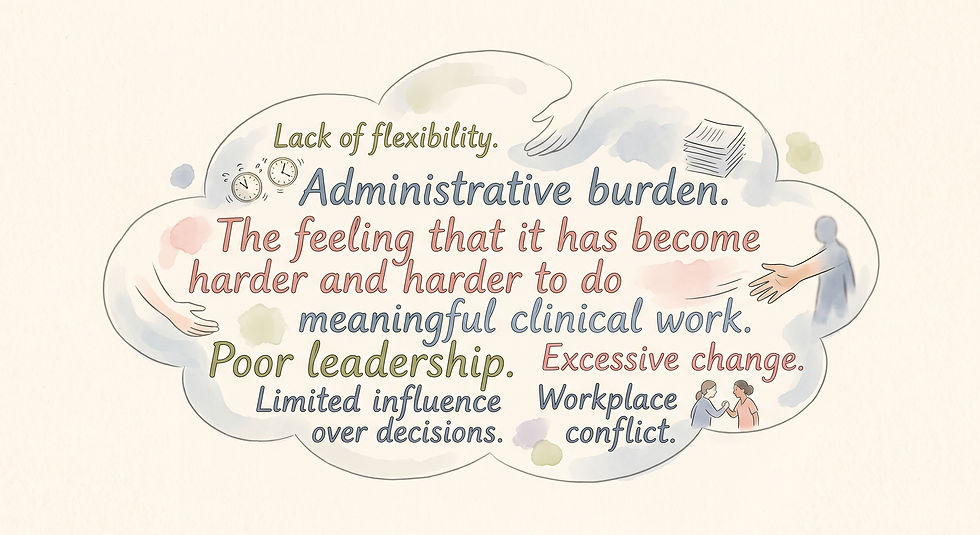
These are not supply problems.
They are conditions problems.
The question is not whether recruitment investment is necessary. It is. The question is whether the balance is right. Every dollar spent recruiting a replacement nurse is a reminder that another nurse has already decided not to stay. Workforce sustainability requires us to ask not only how we can attract people into nursing, but how we can make remaining in nursing the easier choice.
The attrition crisis is an unexamined divide between Work-as-Imagined (the sanitised policies and metrics on executive and government dashboards) and Work-as-Done (the exhausting workarounds nurses must execute just to get through a 12-hour shift).
Many nurses are not leaving because they no longer care about patients. They are leaving because the systems surrounding patient care increasingly make good work more difficult. Digital systems intended to improve efficiency often require multiple workarounds, duplicate documentation or additional administrative effort. Payroll errors and pay delays, while seemingly operational issues, can significantly damage trust when staff must repeatedly chase entitlements they have already earned. Flexible rostering remains inconsistent across many services despite strong evidence that flexibility influences retention, particularly for experienced clinicians balancing family and caring responsibilities.

When nurses experience capable leadership, supportive teams, professional growth and meaningful work, retention follows.
When these conditions deteriorate, turnover follows.
Workforce growth and retention must be discussed together.
One without the other creates an endless cycle of recruitment and replacement.
The nursing workforce challenge is not simply about bringing more people into the profession.
It is also about ensuring that the people who have already committed their careers to nursing continue to see a future within it.

Comments